
Semi-absentee franchises are businesses set up so a hired manager can handle much of the day-to-day work, while the owner stays responsible for leadership, oversight, and results. They are not passive investments, and they usually ask more of you at the start than the name suggests.
I’m Ryan, founder of The Franchise Blueprint. I often talk with professionals who want ownership without being on site every day, or who hope to keep a job while a business gets established. This model can fit some people, but it is easy to misunderstand.
What a semi-absentee franchise usually means
In a typical owner-operator model, you are in the business most days, serving customers, running routes, or supervising the floor. In a semi-absentee model, that daily work is meant to sit with a manager, lead technician, or similar operator.
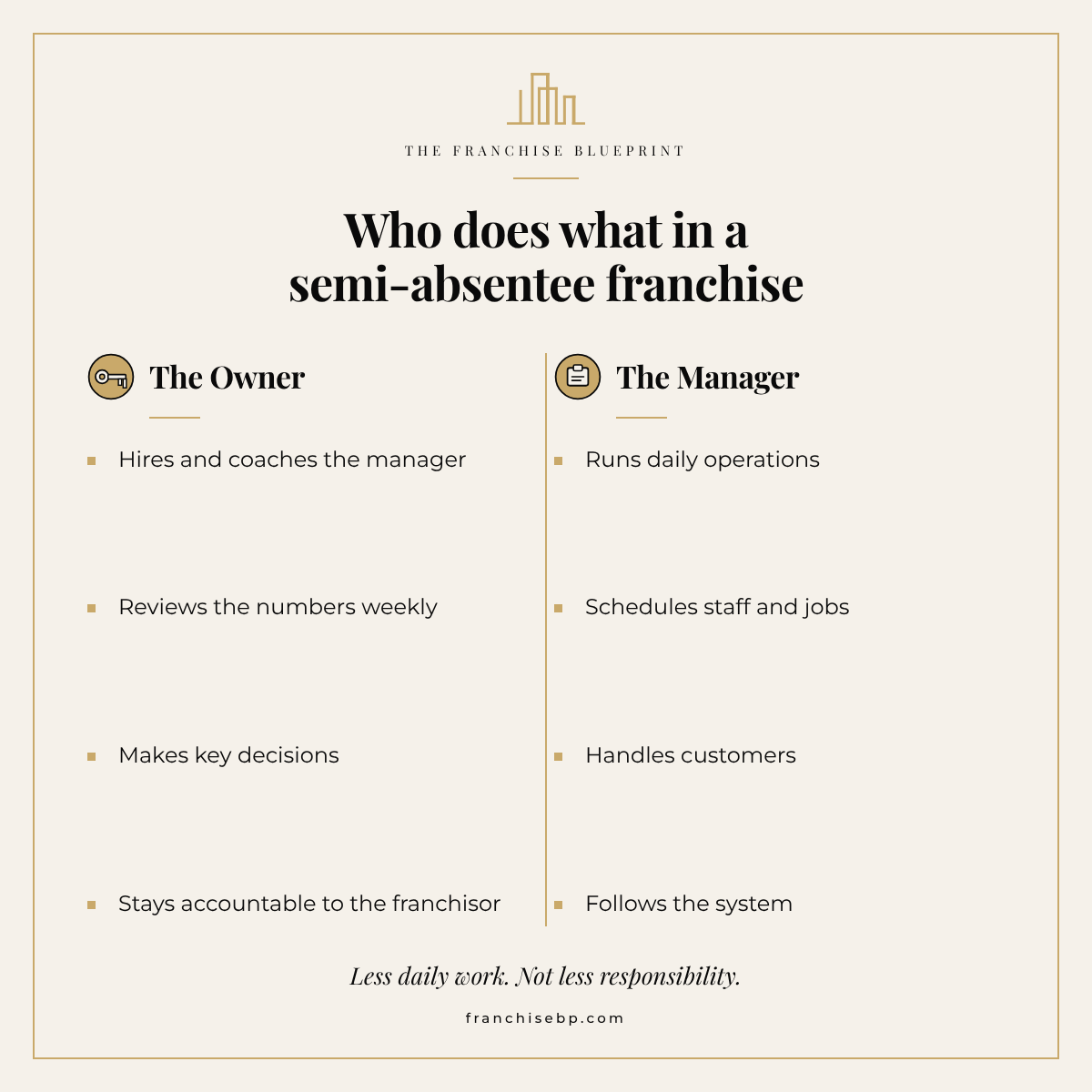
Your role then shifts toward hiring and coaching that person, watching the numbers, making key decisions, and staying accountable to the franchisor’s standards. That is still an active job. You may not be on every service call, but you still own the outcomes if hiring is slow, quality slips, or cash gets tight.
People also use labels such as manager-run, executive, or semi-passive. What matters is how the business actually runs, what the agreement requires, and what current owners say their weeks look like.
What semi-absentee ownership is not
It is not a hands-off income stream. If a conversation focuses on lifestyle and says little about staffing, training, or what happens when a manager leaves, slow down and ask for more detail. It is also not a model you should assume is available on day one. Even when a brand allows a manager to run daily operations, the early months often require more of your time: hiring, learning the system, launching marketing, and building a routine the business can follow without you in the room.
In a 2025 article for Multi-Unit Franchisee Magazine, franchise operations executive Larry Layton, CFE, described a common false belief: that an owner can step back after the first six to eight weeks. His view is that owners should expect to be fully involved for 12 to 18 months while they build the people, processes, and metrics that make a lighter schedule realistic. That is one practitioner’s guidance, not a universal timeline. Ask franchisees what their first year required.
A franchisor’s training and support can be valuable. They do not replace your responsibility to lead the business.
What the FDD says about your role
The Franchise Disclosure Document, or FDD, is required under the FTC’s Franchise Rule. For semi-absentee franchises, start with Item 15, “Obligation to Participate in the Actual Operation of the Franchise Business.”
The franchisor must disclose whether you have to participate personally in the direct operation of the business, and whether it recommends that participation. Those obligations can come from the written agreement or from the franchisor’s practice. If personal on-premises supervision is not required, Item 15 must also disclose:
- Whether the franchisor still recommends that you supervise on site
- Any limits on whom you can hire as an on-premises supervisor
- Whether that supervisor must complete the franchisor’s training program
- If you own the franchise through a company, whether the on-site supervisor must hold an equity interest, and how much
- Restrictions you must place on your manager, such as confidentiality or noncompete obligations
Item 15 tells you what is required or recommended, not how many hours you will work. For that, talk with franchisees and read related FDD sections. Item 11 covers training, including whether a manager must attend. Item 7 estimates the initial investment, including additional funds or working capital; a manager-led model often means you are paying for that leadership during the ramp-up. How much it costs to own a franchise depends on the brand and those line items, not on a single headline fee. Item 20 lists current and former franchisees, which is useful if you want to speak with owners who kept another job or hired a manager early.
By law, a franchisor must give you its current FDD at least 14 calendar days before you sign a binding agreement or make any payment to the franchisor or an affiliate in connection with the proposed sale. The FTC’s Consumer’s Guide to Buying a Franchise is a helpful overview of how to review these disclosures. Have a qualified franchise attorney review the FDD and the agreement before you sign or pay.
Who this model can fit (and who it may not)
This model can be worth exploring if you want ownership and have a reason not to be the full-time operator, such as a career you are not ready to leave or a plan to build a manager-led business over time. It only works if you can still be involved during the launch, are comfortable hiring and coaching a manager, and can support that person’s pay plus a reserve for a slower ramp-up than you hope for.
Service-based franchises, including many home service concepts, are often discussed in this context because they may not require a storefront. That can help, but it does not automatically make the business semi-absentee. You may still be managing people, customers, scheduling, and local marketing. The category is not the answer. The operating design is.
This path may be a poor fit if you want income without management responsibility, cannot give the startup period enough attention, or can only make the numbers work by skipping a qualified manager.
Questions to ask before you rely on the model
When you talk with the franchisor and with franchisees, get past the phrase “semi-absentee” and into the details:
- Does Item 15 allow a manager to run day-to-day operations? Is owner presence required, and for how long after opening?
- Must the manager complete franchisor training? Are there limits on whom you can hire, or a required ownership stake?
- In the first three months, the first year, and after the business is established, how many hours did owners actually work, and how long before they reduced day-to-day involvement?
- What does the owner still handle after a manager is in place, and what happens when that manager quits, underperforms, or takes time off?
- Is a manager’s compensation included in the Item 7 additional-funds estimate, and for how many months?
- From the Item 20 list, can you speak with current and former owners, including people who kept another job or whose experience was mixed?
Listen for specifics. Hours, hiring stories, and cash-flow timing are more useful than claims that the business “runs itself.” If what the FDD requires, what the franchisor describes, and what owners report do not line up, keep asking questions, or walk away.
My role is to help you think through that fit, not to push you toward a particular model or brand. There is no consulting fee to candidates for working with The Franchise Blueprint.
If you want help thinking through whether a manager-led model could match your goals and schedule, you can schedule a discovery call. It is a conversation, not a pitch, and there is no obligation. Candidates in Greater St. Louis and Metro East can also learn more about working with a St. Louis franchise consultant. I work with clients nationwide as well.
Frequently asked questions
What is a semi-absentee franchise?
It is a franchise in which a manager or other operator handles much of the daily work, while the owner remains responsible for oversight, key decisions, and results. Confirm the exact expectations in Item 15 of the FDD and with current franchisees.
Are semi-absentee franchises really passive?
No. Semi-absentee means less involvement in daily tasks, not the absence of responsibility. Hiring, performance, customer experience, and financial results remain yours to manage.
How many hours a week do you have to work?
There is no standard number across brands. It depends on the model, your staffing, the stage of the business, and what the franchisor requires. Hour ranges in marketing materials are not a regulated disclosure and may describe a mature operation, not the launch period. Ask franchisees what they actually worked.
Can I buy a franchise and keep my job?
Some people do, and some brands are more compatible with that plan than others. It only works if the agreement allows a manager-led structure and if you can still give the startup period enough time. Ask franchisees who tried it how they split their weeks.
About the Author
Ryan Gasaway is the founder of The Franchise Blueprint. After more than 15 years in corporate, he evaluated, bought, and operated his own franchise. Today, powered by the FranChoice network, he helps candidates explore opportunities through an educational, no-pressure process. Franchise consulting is provided at no cost to candidates.